


Key Takeaways
- FPV means flying through goggles fed a live camera feed from the drone, not watching it from the ground. - In 2026, one FPV training analysis found sim-trained pilots crash about 2 times in their first 10 real flights. Pilots who skip sim training crash about 20 times in that same span (UAVMODEL Insights, 2026). - Acro mode blends throttle, pitch, roll, and yaw with zero auto-leveling. You can build that skill entirely in a simulator, before you own any hardware.
In 2026, one FPV training analysis found that new pilots crash roughly 20 times in their first 10 real flights. Pilots who put in 10 hours of simulator practice first crash about 2 times in that same span (UAVMODEL Insights, 2026). That's roughly a tenfold difference, and it has nothing to do with talent.
FPV flying looks intimidating from the outside. Four sticks move at once, nothing auto-corrects, and every mistake risks a real quadcopter. Most beginners quit not because they lack coordination, but because they start in the wrong order: hardware first, structure never.
This guide breaks down what FPV actually is and how the four controls work. It covers why simulator training changes the crash math above, and the fastest path to a confident first flight. You don't need a drone to start. You need a plan.
What Is FPV Drone Flying?
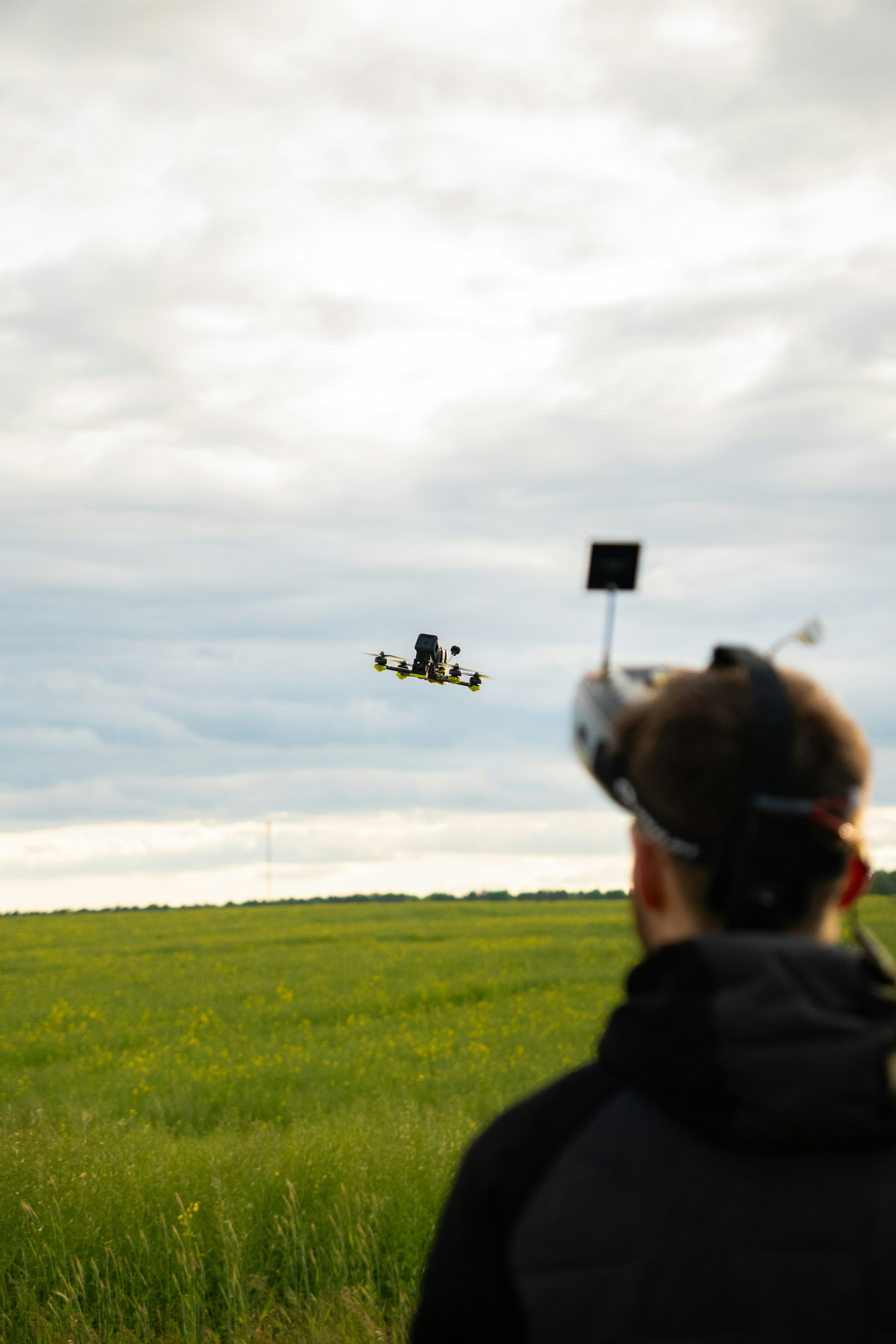
FPV, first-person view, means flying through goggles that stream live video from a camera mounted on the drone. You see exactly what it sees, instead of watching it from the ground. That single difference changes everything about how the aircraft handles.
Camera drones built for photography hold position automatically and avoid obstacles using onboard sensors. FPV racing and freestyle drones do neither. They fly and turn based entirely on pilot input, with no automatic braking or collision avoidance.
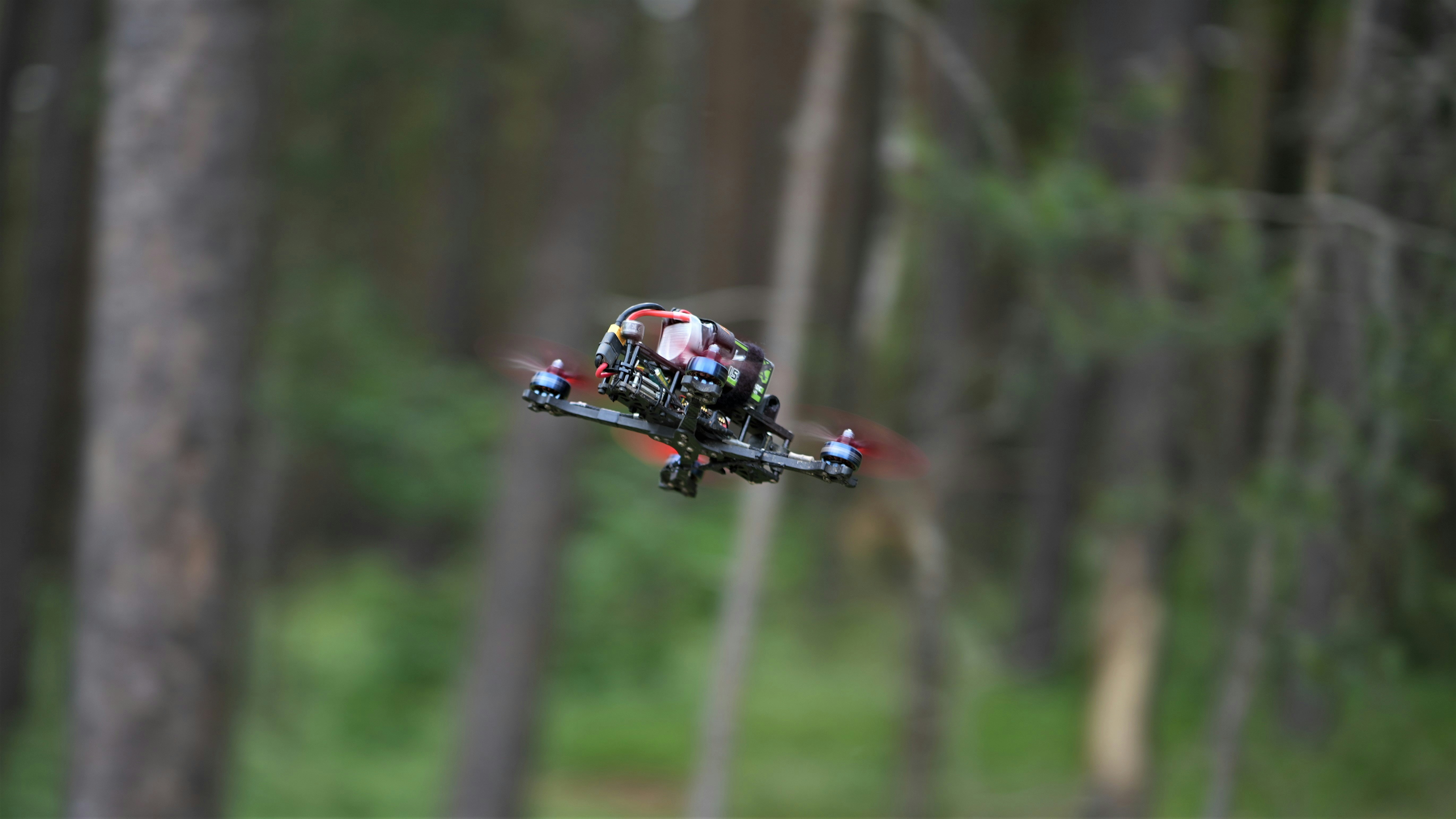
That's a deliberate tradeoff. Removing the automation is what makes tight turns, dives through gates, and fast direction changes possible, but it also means the pilot supplies 100% of the stability. As of 2026, the FPV racing drone market reflects that growing interest. It's projected to expand from $1.42 billion in 2025 to $1.67 billion in 2026, a 17.4% year-over-year increase (Research and Markets, 2026).
FPV Racing Drone Market Size (Billions USD)
The market is projected to keep growing at a double-digit pace into 2026.
- 2025; approximately $1.42
- 2026 (projected); approximately $1.67
FPV isn't a niche anymore, but it's also not a "buy it and figure it out" hobby the way a camera drone can be. What actually separates a smooth first flight from a stack of broken parts is what you practice before you ever pick up real hardware.
The Four Controls: Throttle, Pitch, Roll, Yaw
Every FPV input reduces to four sticks: throttle, pitch, roll, and yaw. In Acro mode, the flight controller blends all four with zero auto-stabilization (Drone Racing League, FPV 101: Phase 1, Episode 7, 2026). Once you understand what each one physically does, the rest is timing and repetition.
Throttle raises or lowers all four motors' speed equally, controlling altitude. It's independent of orientation: throttle still climbs or descends the drone even mid-turn.
Pitch tilts the drone forward or backward, which is what actually moves it through the air. Pushing the stick forward tilts the back up and drives the drone ahead.
Roll tilts the drone left or right, banking it into a turn the way a plane's wings do.
Yaw spins the drone around its vertical axis without changing its position: think of it as turning in place.
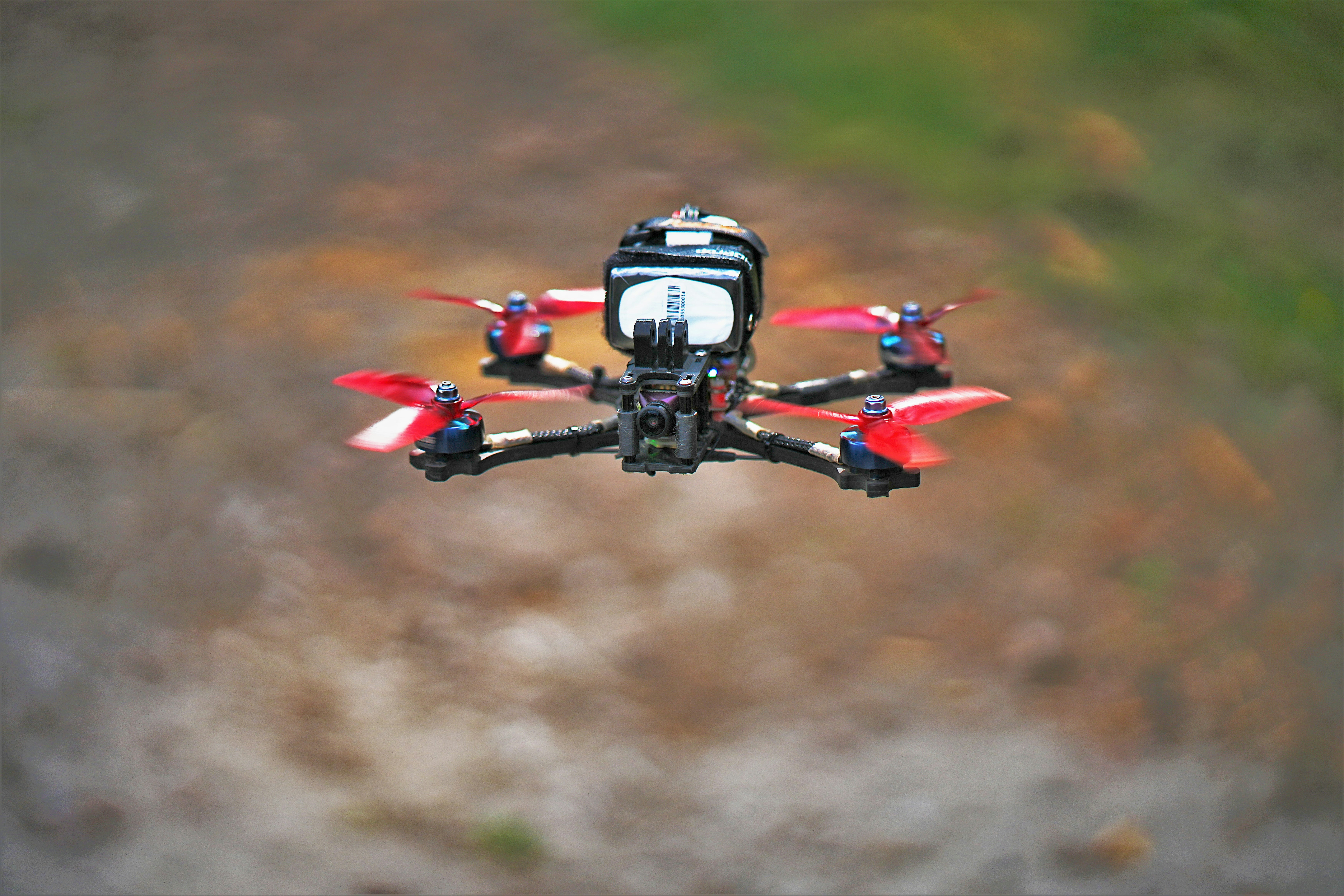
Here's the part most beginner explainers skip: these four inputs don't work in isolation. The single most common beginner mistake is over-relying on yaw or roll alone instead of blending all four together. A turn that feels wide and floaty is almost always missing one ingredient, most often yaw or throttle (MattyFleisch, 2026; UAV Drone Academy, 2026).
There's also a habit trap specific to Acro mode. The drone keeps moving in whatever direction you last commanded until you actively correct it. It will not stop or level itself on its own (Drone Racing League, FPV 101: Phase 1, Episode 7, 2026; UAV Drone Academy, 2026). Beginners who expect it to self-stop are the ones who tend to fly into things.
Acro Mode vs. Angle Mode: Which Should You Learn First?
Angle mode auto-levels the drone the moment you release the sticks, while Acro mode removes stabilization entirely and hands you direct rotation-rate control (Unmanned Tech, 2026). Angle feels safer at first. Acro is the mode almost every FPV pilot eventually needs.
That's the tension. Angle mode is genuinely easier for a first five minutes of flight, but the habits it builds don't transfer cleanly to Acro, because you're leaning on a stabilization crutch that Acro simply doesn't have. Pilots who spend too long in Angle or Horizon mode often have to unlearn timing before Acro clicks.
| Angle Mode | Acro Mode | |
|---|---|---|
| Stabilization | Auto-levels the instant you release the sticks | None: you hold every attitude yourself |
| First-flight difficulty | Easier out of the gate | Steeper at first, no safety net |
| Long-term ceiling | Limits tight racing lines and freestyle tricks | Required for racing, freestyle, and gate work |
| Where to learn it | Either works | Directly, in a simulator, where crashes cost nothing |
The practical answer: learn Acro directly, in a simulator, where a crash costs nothing. As of 2026, experienced instructors commonly recommend 10 to 20 hours of simulator practice before a pilot's first real Acro flight (UAVMODEL Insights, 2026; Oscar Liang, 2026). That range shows up across multiple independent beginner guides, not just one source.
Isn't it worth asking why so many guides converge on roughly the same number? Because the failure mode they're all describing, muscle memory built on a crutch, then relearned the hard way, is common enough that it's become conventional wisdom.
Why Simulator Training Comes First
In 2026, an FPV training analysis found that pilots who logged around 10 hours in a simulator crashed about 2 times in their first 10 real flights. Pilots who skipped sim training entirely crashed roughly 20 times in that same span (UAVMODEL Insights, 2026). That's a tenfold gap driven entirely by preparation, not equipment.
Crash Count in Your First 10 Real Flights
Pilots who train in a simulator first crash far less often once they fly for real.
- No sim training; approximately 20
- 10+ hrs sim training; approximately 2
What actually carries over from sim to real flight? Stick coordination, spatial awareness, and trick timing: the core motor skills of blending throttle, pitch, roll, and yaw together (UAVMODEL Insights, 2026). Those are exactly the skills that take the longest to build and are safest to build with nothing at stake.
What doesn't transfer as cleanly: the exact feel of the drone's weight, drag, and inertia. Every simulator is only an approximation. The transfer rate also drops on more aggressive maneuvers, where real crash risk introduces tension that doesn't exist in a sim (UAVMODEL Insights, 2026). Sim training builds the foundation; it isn't a full substitute for real-world flying.
What Structured Practice Looks Like
Free-flying in a simulator without a curriculum teaches some good habits and reinforces just as many bad ones. Deliberate, ordered skill-building consistently outperforms unstructured stick time. This is the part most beginner guides gloss over entirely.
Nearly every FPV beginner guide treats "get a simulator" as step one of a gear-buying checklist, then moves on. That framing misses the actual lesson: sim time only compounds into real skill when it follows a sequence, the way flight school teaches pilots in order rather than letting them wander the syllabus.
A lesson-based approach builds one skill at a time, in the order each depends on the last. Takeoff and forward flight come first, then turning without losing altitude, then a controlled stop, then gates and obstacles under control. Skipping ahead to gates before you can stop reliably just relocates the crash. It doesn't prevent it.
In FlightDivision's own curriculum, that order is explicit: Takeoff and Forward, then Turns, then Stopping, then Stay Calm, then Basic Tricks, then Flow. Students who try to jump to Basic Tricks before finishing Stopping tend to plateau: they've built confident forward flight but never practiced the control that actually keeps them out of trouble.
Handling Crash Anxiety and the Beginner Plateau
Nearly every beginner hits a point where fear of crashing, not lack of physical skill, is what's actually holding their flying back, and that fear fades fastest when the stakes are genuinely zero. It's a normal phase, not a sign you're bad at this.
Real hardware makes that fear rational: every crash risks a broken frame, a snapped prop, or a cracked camera. That tension shows up in your stick inputs as hesitation, and hesitation is exactly what causes the wobbly, over-corrected flying that looks like a lack of skill.
A simulator removes the cost of the mistake without removing the mistake itself. You still crash, you still learn what caused it, but nothing breaks and nothing gets more expensive. That's not a workaround for building confidence: it's the actual mechanism.
A short, low-stakes crash inside a structured lesson also isolates one variable at a time, usually a single stick input, not a character flaw. A real-world crash under financial pressure and adrenaline rarely gives you that clean a signal.
Getting Started: What You Actually Need
You can start FPV entirely in a browser-based simulator with no hardware purchase at all. A controller comes later, once you've built basic stick coordination. That's the lowest-friction first step, and it costs nothing to try today.
When you're ready to move to real hardware, the budget varies widely depending on whether you buy a ready-to-fly kit or build your own. Goggles, a transmitter, and a beginner-friendly quad or micro are the essentials either way. This guide deliberately won't recommend specific gear or brands.
What matters more than which drone you eventually buy is whether you've already built the stick skills that keep it in one piece. MultiGP, the largest FPV racing league, now counts more than 30,000 registered pilots (MultiGP, 2026), proof this hobby has real staying power, and proof there's no rush to buy before you're ready.
Ready to start? Fly your first lesson in the FlightDivision simulator. No hardware required.
Frequently Asked Questions
FPV means flying via goggles that stream a live first-person camera feed from the drone, unlike photography drones flown by watching from the ground. It removes auto-hold and obstacle avoidance, putting full control in the pilot's hands.
Most beginner guides converge on 10 to 20 hours of focused simulator practice before a first real flight (UAVMODEL Insights, 2026; Oscar Liang, 2026). Structured, lesson-ordered practice tends to get there faster than free-flying the same number of hours.
Yes, for stick coordination, spatial awareness, and timing: the core motor skills of blending throttle, pitch, roll, and yaw (UAVMODEL Insights, 2026). The exact weight and inertia feel of real hardware only transfers approximately.
Angle mode is easier for the first few minutes, but Acro is the mode most pilots need long term, so learning it directly avoids relearning habits later. A simulator is the safest place to make that first attempt, since crashes there cost nothing.
No. Foundational stick skills like throttle, pitch, roll, and yaw coordination can be built entirely in a simulator first. Real hardware becomes worth buying once you can already fly the basics reliably.
Conclusion
The single most important thing to remember: the gap between a rough first flight and a confident one isn't talent, it's preparation. Sim-trained pilots crash roughly ten times less often in their first ten real flights than pilots who skip that step.
You now know what FPV actually is, what the four controls do, why Acro mode is worth learning directly, and why structured practice beats random stick time. None of it requires owning hardware yet.
When you are ready to choose a first aircraft, What to buy for FPV covers the radio, goggles, and whoop order. Keep the sim hours first.
FPV isn't slowing down. The market behind it is growing at a double-digit clip, and more people are finding their way in every year. Start where the crash math favors you: in a simulator, with a curriculum, before you spend a euro on hardware.
Start the Takeoff and Forward course in the FlightDivision simulator.
Sources
- UAVMODEL Insights, FPV Simulator Training: Liftoff vs Velocidrone vs Uncrashed, Which Actually Translates to Real Flying, 2026 Guide, retrieved 2026-08-11, https://blog.uavmodel.com/fpv-simulator-training-liftoff-vs-velocidrone-vs-uncrashed-which-actually-translates-to-real-flying-2026-guide/
- UAVMODEL Insights, FPV Simulator Training: Liftoff vs VelociDrone vs Uncrashed, Building Real-World Muscle Memory, 2026 Guide, retrieved 2026-08-11, https://blog.uavmodel.com/fpv-simulator-training-liftoff-vs-velocidrone-vs-uncrashed-building-real-world-muscle-memory-2026-guide/
- UAVMODEL Insights, Beginner Guide to FPV Simulators: Training Before Your First Flight, retrieved 2026-08-11, https://blog.uavmodel.com/beginner-guide-to-fpv-simulators-training-before-your-first-flight/
- Oscar Liang, How To Get Started With FPV Drone, The Ultimate Beginner's Guide, retrieved 2026-08-11, https://oscarliang.com/fpv-drone-guide/
- Research and Markets, First-Person View (FPV) Racing Drone Global Market Report 2026, retrieved 2026-08-11, https://www.researchandmarkets.com/reports/6226766/first-person-view-fpv-racing-drone-global
- Drone Racing League, FPV drone controls explained, throttle, pitch, roll, yaw (FPV 101: Phase 1, Episode 7), retrieved 2026-08-11, https://www.youtube.com/watch?v=cXCXRbkWiio
- UAV Drone Academy, Chapter 30: First FPV Flight Tips: How to Avoid Common Beginner Mistakes, retrieved 2026-08-11, https://www.uavdroneacademy.com/en/blog/first-fpv-flight-tips-how-to-avoid-common-beginner-mistakes
- MattyFleisch, FPV Cornering, How to Mix Roll Pitch Throttle & Yaw for Tightness, retrieved 2026-08-11, https://mattyfleisch.com/fpv-cornering/
- Unmanned Tech, FPV Flight Modes: Angle vs Horizon vs Acro vs Acro Trainer, retrieved 2026-08-11, https://www.unmannedtechshop.co.uk/blogs/knowledge-base/fpv-drone-flight-modes-explained-angle-horizon-acro
- MultiGP, Global Qualifier, retrieved 2026-08-11, https://www.multigp.com/globalqualifier/


